
Uzbek Language Classes
An eight-week practical course in Uzbek grammar and everyday conversation, run every semester for international students at TIU.
Learn the language of the city you live in
Tashkent becomes a different place once you can read a sign, order lunch or ask a question in Uzbek. That is what this course is for: not an academic qualification, but enough of the language to live comfortably and to feel at home on campus.
The classes are practical. Each session mixes a short grammar point with speaking practice, so you use what you have just learned before you leave the room.
They are taught by a TIU student from the foreign languages programme — someone who studies alongside you and knows which words you will actually need first.
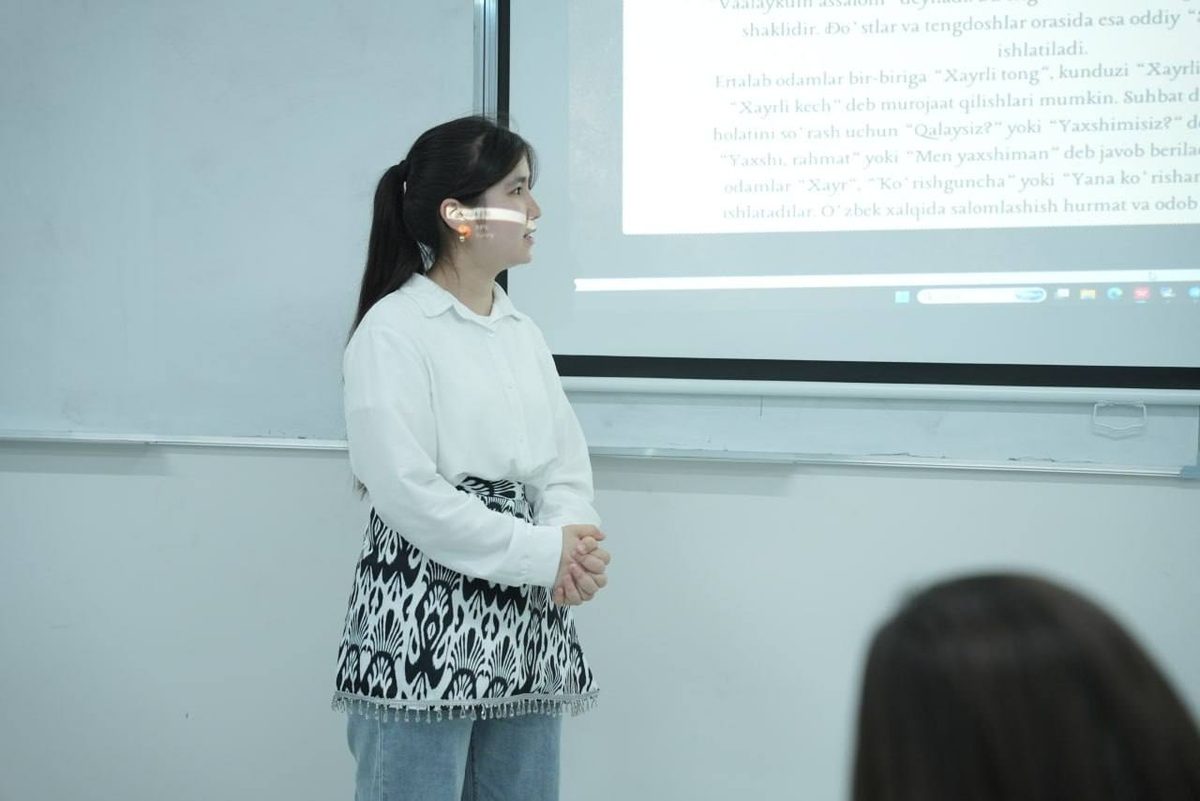
Eight weeks, and you start speaking
The course runs once every semester and lasts eight weeks, so there is always a next intake to join. You do not need to know a single word of Uzbek before you start — the first week begins with the alphabet, not with a placement test.
Classes are on Wednesday and Friday from 14:00 to 15:50, which keeps them clear of most lecture timetables. Groups are kept small, and every session pairs a short grammar point with speaking practice, so you use what you have just learned before you leave the room.
- Eight weeks a semester. One full course each term, with a new group starting the semester after.
- Two classes a week. Wednesday and Friday, 14:00 to 15:50 on both days.
- Grammar and speaking together. Never one without the other — every rule is practised out loud in the same lesson.
- No prior Uzbek required. The first lesson starts from the alphabet and the sounds of the language.
- Taught by a TIU student. Someone from the foreign languages programme who knows which words you will need first.
- Open to every international student. Any faculty, any year of study.

From the alphabet to your first real conversation
The eight weeks move in three stages. Each one pairs a grammar topic with the places in Tashkent where you will actually use it.
Finding your feet
The first three weeks are about being able to open your mouth at all. You learn to read the Latin alphabet, produce the sounds that do not exist in your own language, and say the handful of sentences you will use ten times a day.
- Week 1 — Alphabet, sounds and greetings. Reading and pronunciation, then Assalomu alaykum, Xayrli tong, Qalaysiz? and Mening ismim…
- Week 2 — Pronouns, numbers and the campus. Simple statements and counting, used to talk about your faculty, your group and your timetable.
- Week 3 — Plurals and belonging. Plural forms and possessive endings, for talking about family, friends and where you are from.
Out in the city
The middle of the course moves outside the classroom. These are the weeks that change how you get through an ordinary day in Tashkent — the metro, the bazaar, a queue in the canteen, a taxi driver asking where you are going.
- Week 4 — Getting around Tashkent. The cases you need for places and directions: the metro, taxis, addresses and asking the way.
- Week 5 — Present tense and everyday errands. Shopping in a shop and at the bazaar, asking the price and understanding the answer.
- Week 6 — Past tense, food and eating out. Ordering plov, somsa and lagmon, and telling someone what you did yesterday.
Asking properly, and why it matters
The last two weeks are about tone. Uzbek has a polite form for almost everything, and using it is the difference between being understood and being welcome. The course closes with the culture behind those forms and a full review.
- Week 7 — Future tense and polite requests. How to ask for something at the clinic, at the dormitory and at a university office.
- Week 8 — Culture, values and review. Traditions, hospitality and the forms of respect behind everyday speech, then a review of the whole course and a final conversation session.
Small groups, a lot of speaking
Groups are kept small so that everyone speaks in every lesson. Alongside the language itself, the sessions introduce the culture and values that explain why things are said the way they are.
The aim is simple: by the end of the eight weeks you can hold a basic conversation and handle everyday situations on your own.
Talk to the support center
How to join the next course
Send an email with your name, faculty and year of study, and you will be added to the group for the next intake. There is no entrance test — beginners are welcome.